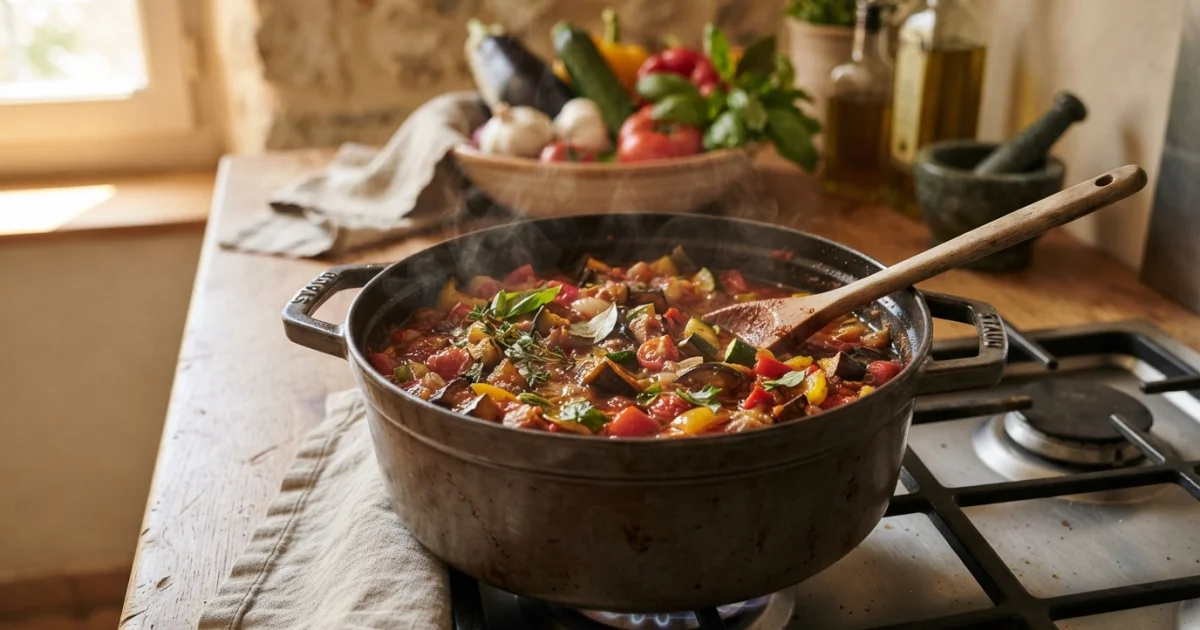
Walk through the Cours Saleya market in Nice on a warm late-summer morning, and the air smells intensely of sweet earth, bruised basil, and warm stone. Baskets overflow with violet-skinned eggplants, slender pale courgettes, glossy sweet peppers, and sun-swollen heirloom tomatoes that perfume the street before you even see them. This produce is the living foundation of genuine ratatouille: an unpretentious, slow-braised vegetable stew rooted in the sun-drenched terroir of Provence. Authentic ratatouille is neither a quick sheet-pan traybake nor a delicate, layered restaurant terrine. It is a patient, soulful stovetop preparation where each vegetable is treated with deliberate respect, browned in generous quantities of fruity extra-virgin olive oil, and gently coaxed into a melting, cohesive ragout.
History and Provençal Origins: From Peasant Rations to Culinary Heritage
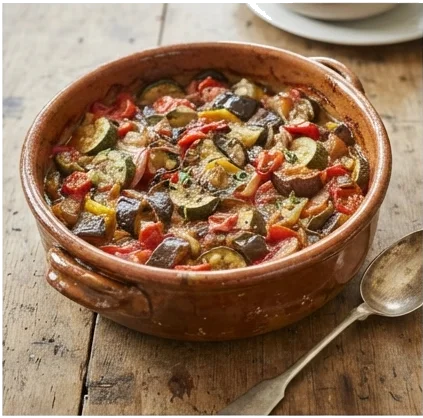
Ratatouille was born out of seasonal abundance and rural necessity across the rolling countryside and coastal towns of southeastern France, with its culinary epicenter firmly anchored in Nice. The word itself traces its lineage to the Occitan verb ratatolha, which literally translates to "to stir up," "to churn," or "to toss together"—an apt linguistic snapshot of a cook turning a wooden spoon through a brimming copper cauldron of summer vegetables.
Historically, Provençal gardeners faced a predictable late-summer phenomenon: an overwhelming garden glut. Between July and September, nightshades and squash ripened at a pace that far outstripped daily consumption. Peasant cooks, unwilling to let a single ounce of harvest spoil, developed a method of stewing these vegetables together in local olive oil, transforming perishable bounty into a sustaining, nutrient-dense medley that could sit at the back of the hearth for days. In its earliest eighteenth-century iterations, the term was often used colloquially—and sometimes pejoratively—in French military slang to describe an indiscriminate soldiers' ration or a watery, boiled vegetable ragout.
Over the decades, however, Provençal home cooks codified the preparation, turning coarse peasant rations into an art form celebrated across France. The dish shares unmistakable Mediterranean lineage with neighboring regional traditions: Catalonia's sweet-and-savory samfaina, Mallorca's tumbet, central Italy's ciambotta, and Sicily's sweet-sour caponata. Yet authentic ratatouille niçoise maintains its own distinct personality—eschewing capers, pine nuts, or vinegar in favor of the pure, concentrated sweetness of vegetables, garlic, and wild thyme.
Traditional Stew vs. Confit Byaldi: Dismantling the Pixar Movie Myth
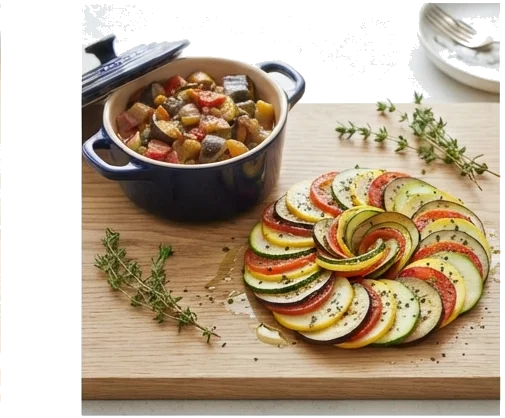
Mention ratatouille in modern culinary conversations, and the immediate mental image for many is an exquisitely engineered spiral of wafer-thin, alternating vegetable rounds arranged like a geometric rosette in an enameled gratin dish. This presentation, immortalized by the 2007 animated film Ratatouille, is undeniably breathtaking. It is also not traditional ratatouille.
The cinematic dish presented on the silver screen is actually confit byaldi, an haute-cuisine reimagining created in 1976 by legendary French chef Michel Guérard, one of the founding fathers of nouvelle cuisine. Guérard sought to lighten the rustic, oil-rich classic by stripping out the heavy sautéing, mandoline-slicing the vegetables into paper-thin discs, and baking them over a delicately seasoned pepper-and-tomato compote (a piperade). Renowned American chef Thomas Keller served as the culinary consultant for the film, adapting Guérard's concept into the iconic accordion-layered presentation that captured the world's imagination.
While confit byaldi is an artistic, elegant baked terrine, authentic Provençal ratatouille is unabashedly rustic, deeply comforting, and prepared entirely on the stovetop. Real ratatouille is a rich, chunky stew where the vegetables do not hold their crisp, rigid boundaries; instead, their edges soften, their internal sugars caramelize, and their juices surrender to the olive oil, forming a luxurious, glossy emulsion that coats the tongue. Understanding this distinction is the first step toward genuine culinary mastery.
The Anatomy of Provençal Ingredients
Because traditional ratatouille relies on a remarkably concise list of garden staples, there is no culinary shield behind which poor ingredients can hide. The final dish is an unvarnished mirror of your produce, your olive oil, and your patience.
Vegetable Selection: Sourcing, Texture, and Sizing
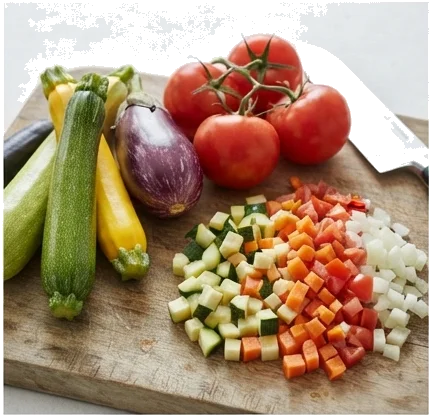
Every element in the pot serves a physical and textural purpose. Sourcing small to medium-sized zucchini (courgettes) is paramount; overgrown summer marrow is laden with spongy, water-logged seed cavities that turn instantly to mush when cooked. Look for firm, slender zucchini with unblemished skins whose flesh remains tight and dense.
For the eggplant (aubergine), select medium Italian or standard globe varieties that feel heavy for their size, with glossy, taut skins that spring back when pressed gently with a thumb. Avoid oversized, dull-skinned specimens, which contain mature seeds that disrupt the stew's velvety texture.
When selecting bell peppers, choose firm, heavy red, yellow, or orange varieties. Avoid green bell peppers entirely for this preparation; harvested before natural sugars develop, green peppers contain an aggressive pyrazine-driven bitterness and astringency that clashes violently with the gentle sweetness of the stew. Finally, tomatoes must be profoundly ripe. If you are cooking in high summer, seek out fragrant, deeply colored beefsteak or heirloom varieties. If you are cooking outside of peak tomato season, strictly avoid pale, mealy supermarket tomatoes; substitute them with high-grade, whole canned San Marzano or Italian plum tomatoes crushed lightly by hand.
Cut all vegetables into uniform, rustic one-inch chunks. This sizing ensures the pieces are large enough to retain their individual character through an extended simmer, yet small enough to integrate onto a single soup spoon.
Aromatics, Fats, and Herbes de Provence
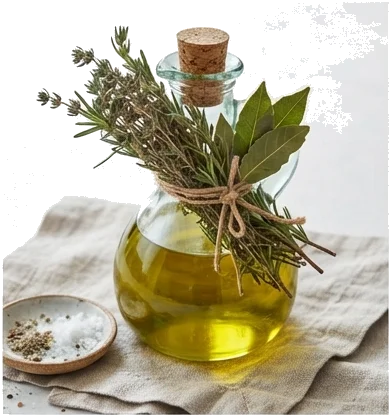
In classical Provençal cooking, extra-virgin olive oil is treated not merely as a lubricant to keep food from sticking to metal, but as a primary structural ingredient and flavor carrier. You will need a generous hand—at minimum one-third to one-half cup of high-quality, cold-pressed olive oil with fruity, slightly grassy notes.
The aromatic backbone consists of sweet yellow onions cut into wide half-moons, plenty of freshly minced garlic (four to six cloves), sturdy sprigs of fresh garden thyme, and dried bay leaves. Freshly torn basil leaves must be kept aside until the very end; their volatile aromatic oils, particularly linalool, degrade rapidly under heat and should only perfume the warm, resting stew. A splash of dry white wine—such as a Provençal Rolle or crisp Sauvignon Blanc—provides necessary malic and tartaric acidity to deglaze the pot, and a tiny pinch of sugar can be deployed judiciously if your tomatoes carry excess sharp acidity.
Culinary Science: Why Vegetables Must Be Cooked Separately
The single greatest mistake made in domestic kitchens is the "one-pot dump": tossing raw eggplant, zucchini, peppers, onions, and tomatoes into a pot together and turning on the heat. The result of this shortcut is universally disappointing—a dull, watery, grey-tinted vegetable porridge.
The failure lies in fundamental food chemistry. Summer vegetables are composed predominantly of water: zucchini and tomatoes hover around 94% water, while eggplant and sweet peppers sit at roughly 92%. When these vegetables are thrown into a crowded pot simultaneously, the thermal energy of the pan is rapidly depleted. Instead of sizzling at caramelizing temperatures (above 140°C / 284°F), the trapped internal juices escape, the temperature plunges to 100°C (212°F), and the vegetables effectively boil and steam in their own pooled liquids.
Steaming completely halts the Maillard reaction—the complex chemical interaction between amino acids and reducing sugars that produces deep, savory roasted flavor compounds. Furthermore, the cell wall structures of these vegetables collapse at different thermal rates. Zucchini softens within minutes, while peppers require prolonged heat to break down their fibrous epidermal layers.
By searing each vegetable family independently in hot olive oil, you accomplish two critical technical goals. First, you rapidly evaporate surface moisture, allowing the exterior sugars to caramelize into rich, golden hues that provide depth to the finished stew. Second, you set the pectin in the cell walls, ensuring each vegetable retains its distinct structural shape and textural bite through the subsequent braising phase.
The Eggplant Salting Debate: Moisture vs. Bitterness
Culinary literature is filled with dogmatic commands to generously salt raw eggplant before cooking to "purge its bitter juices." In modern agriculture, this justification is largely outdated. Over the past several decades, commercial plant breeders have successfully eliminated the bitter solanine glycoalkaloids that historically plagued older heirloom eggplant varieties.
Yet, experienced Provençal cooks continue to salt their eggplant—and the food science completely supports the practice, albeit for an entirely different reason: cellular mechanics.
Raw eggplant flesh resembles a rigid sponge, composed of thousands of tiny, air-filled parenchyma cells. When you drop unsalted eggplant directly into hot oil, those micro-cavities act like vacuum chambers, drinking up enormous amounts of olive oil before the vegetable has even begun to brown. Later in the cooking cycle, as the cell walls finally collapse from heat, the trapped oil is expelled back into the pot, resulting in a greasy, cloying mouthfeel.
Salting the cut eggplant chunks for 20 to 30 minutes initiates a process of osmosis. Sodium ions draw free intracellular water out through the semi-permeable cell membranes to the surface. As the water is expelled, the delicate cellular air pockets collapse under atmospheric pressure. When you rinse away the surface salt and firmly pat the cubes dry with clean kitchen towels, you are left with dense, pre-collapsed eggplant flesh that sears quickly in a modest film of oil, browning beautifully on the outside while maintaining a creamy, silken interior.
Step-by-Step Stovetop Masterclass Execution
Set up your workstation with all vegetables pre-cut before applying heat. A heavy-bottomed, enameled cast-iron Dutch oven (such as a 5- to 7-quart capacity) is the ideal vessel; its thick walls distribute heat evenly, preventing scorching while providing the surface area necessary for developing a rich fond.
Phase 1: Mise en Place and Individual Sautéing
Prepare your vegetables according to standard dimensions: one-inch uniform cubes for the salted and dried eggplant, one-inch thick half-moons for the zucchini, and one-inch squares or strips for the deseeded bell peppers.
- The Eggplant: Set your Dutch oven over medium-high heat and pour in two tablespoons of extra-virgin olive oil. Once the oil ripples, add the prepared eggplant in a loose, single layer. Sauté undisturbed for 3 to 4 minutes to allow a deep golden crust to form, then stir and cook for an additional 4 to 5 minutes until tender and caramelized on all sides. Transfer the eggplant to a wide rimmed platter and set aside.
- The Zucchini: Add another tablespoon of oil to the pot. Add the zucchini chunks. Sauté over high heat for 6 to 8 minutes, tossing periodically. You want distinct golden-brown edges while the interior core remains slightly firm to the bite. Transfer to the platter with the eggplant.
- The Peppers: Add a final slick of olive oil to the pot and introduce the sweet peppers. Sauté over medium heat for 6 to 7 minutes until the skins soften and show slight blistered, charred freckles. Transfer the peppers to the holding platter.
Phase 2: Building the Aromatic Fond and Tomato Base
With your seared vegetables resting, your pot now possesses a rich base layer of caramelized vegetable sugars—known as the fond—stuck to the bottom.
- Aromatics: Reduce the heat under the Dutch oven to medium-low. Add two tablespoons of fresh olive oil and add the sliced onions along with a pinch of sea salt. Cook gently for 6 to 8 minutes, scraping the bottom of the pot with a wooden spoon as the onions release their moisture, until they turn translucent, sweet, and lightly golden.
- Garlic and Deglazing: Add the minced garlic and cook for precisely 60 seconds, stirring constantly. Garlic burns easily; you only want to tame its raw sulfurous bite until its perfume rises from the pot. Pour in a splash (about 1/4 cup) of dry white wine to deglaze, vigorously scraping up every scrap of browned fond from the bottom. Let the wine reduce until nearly dry, about 2 minutes.
- Tomatoes and Herbs: Add your chopped ripe tomatoes (or hand-crushed San Marzanos) along with their juices, the fresh thyme sprigs, and two bay leaves. Season with a half teaspoon of sea salt and several grinds of black pepper. Simmer the tomato mixture uncovered over medium heat for 10 to 12 minutes, stirring occasionally, until the tomatoes collapse into a rich, thickened, bubbling sauce and beads of fragrant olive oil begin to separate along the perimeter.
Phase 3: The Unified Simmer and Final Finish
Now comes the alchemical union where individual voices merge into a cohesive chorus.
- The Assembly: Gently pour the reserved seared eggplant, zucchini, and peppers—along with any flavorful juices that have pooled on the platter—back into the Dutch oven. Using a broad silicone spatula or wooden spoon, gently fold the vegetables through the tomato sauce. Treat the tender vegetables gently; do not stir aggressively, or you will crush the zucchini and eggplant into paste.
- The Gentle Braise: Adjust your burner to the lowest possible setting. Cover the Dutch oven partially with its lid, leaving a finger-width gap to allow steam to slowly escape. Let the ratatouille simmer lazily for 30 to 40 minutes. Check the pot every 10 minutes, giving it a gentle, slow lift-and-fold from the bottom to ensure nothing catches. When finished, the vegetables should be yielding and butter-soft, suspended in a thick, unctuous sauce that glistens with oil.
- The Resting Finish: Remove the pot from the heat. Discard the spent thyme sprigs and bay leaves. Taste for seasoning, adding a touch more sea salt or freshly cracked pepper if needed. Drizzle two tablespoons of your finest raw extra-virgin olive oil over the top, scatter a generous handful of hand-torn fresh basil leaves across the surface, and let the pot sit undisturbed for at least 20 minutes before serving.
Common Technical Mistakes and How to Avoid Them
Even seasoned home cooks frequently stumble over small technical details when making ratatouille. Review these critical pitfalls before lighting your burner:
- Pan Overcrowding: If you try to sauté all your eggplant or zucchini in a single layer inside a small pan, you will cause thermal collapse. If your Dutch oven is under 6 quarts, sear each vegetable family in two smaller batches rather than one crowded pile.
- Micro-Dicing: Slicing your vegetables into tiny, quarter-inch brunoise cubes might look neat on a cutting board, but it destroys the stew. Small dice disintegrate completely during a 40-minute braise, leaving you with an indistinct baby food consistency. Maintain bold, 1-inch pieces.
- Fat Parsimony: Treating olive oil as a reluctant dietary evil will ruin this dish. Olive oil in Provençal cooking is an essential structural element; its lipids emulsify with the natural pectins and tomato sugars, providing the silky mouthfeel that defines the dish. Use the prescribed amounts.
- Using Out-of-Season Supermarket Tomatoes: Rock-hard, pale pink winter tomatoes contain mostly water, cellulose, and sharp acidity with zero aromatic sweetness. If excellent vine-ripened tomatoes are unavailable, use high-grade canned whole plum tomatoes every time.
- Overcooking the Zucchini Early: If your zucchini is completely soft during the initial sear, it will completely liquefy during the final braise. Sear it hot and fast so the core remains firm before joining the tomato base.
- Rushing the Simmer: Boiling ratatouille over high heat to save time breaks the vegetables, scorches the tomato sugars, and prevents the distinct flavors from gently harmonizing. Low, steady heat is non-negotiable.
Pairings, Service Traditions, and Make-Ahead Science
One of the great culinary truths of ratatouille is that it is fundamentally better the following day. When hot, the volatile aromatic compounds are dispersed and the vegetable textures remain distinct. As the stew cools slowly overnight in the refrigerator, fascinating food chemistry takes place: the pectin from the cell walls sets, natural sugars equalize through diffusion, and the aromatic oils from garlic, thyme, and olive oil penetrate deep into the flesh of the eggplant and squash. The stew transforms into a seamless, unified emulsion.
| Serving Style | Culinary Context | Ideal Wine Pairing |
|---|---|---|
| Warm with Crusty Bread | Classic Provençal supper; crusty sourdough or rustic pain de campagne to mop up the emulsified juices. | Dry Provençal Rosé (Bandol, Coteaux d'Aix-en-Provence) |
| Accompaniment to Fish/Poultry | Served alongside seared sea bass (loup de mer), grilled red mullet, or slow-roasted herb chicken. | Crisp, minerally Vermentino (Rolle) or Cassis Blanc |
| Room Temperature / Next Day | Spoon over soft polenta, grains, or serve atop toasted rustic toast crowned with a soft-poached farm egg. | Low-tannin, light-bodied red like Cru Beaujolais or chilled Chinon |
For storage, allow the ratatouille to cool completely to room temperature before transferring it to an airtight glass container. It will keep beautifully in the refrigerator for up to 4 days, deepening in flavor with each passing afternoon. In Provence, leftovers are often enjoyed cold or at room temperature alongside salted goat cheese, olives, and crisp radishes for lunch.
Ratatouille also freezes remarkably well. Pack the chilled stew into airtight freezer containers or heavy-duty freezer bags, leaving half an inch of headspace for liquid expansion. It can be frozen for up to 3 months without noticeable loss of quality. To reheat, thaw overnight in the refrigerator and warm gently in a wide skillet over low heat, finishing with a fresh splash of raw olive oil and a scatter of newly picked basil to revive its vibrant, sunny personality.
Frequently Asked Questions
What is the secret to a great traditional ratatouille?
The definitive secret to authentic ratatouille is cooking each vegetable family separately in generous amounts of olive oil before combining them. Searing the eggplant, zucchini, and peppers independently allows each vegetable to brown, develop roasted flavor compounds via the Maillard reaction, and preserve its structural integrity without steaming into a watery mush.
Why is my ratatouille watery or soggy?
Ratatouille turns watery when all the raw vegetables are dumped into a single pot together. Because summer vegetables are over 90% water, overcrowding causes them to steam and boil in their own trapped moisture instead of searing. To fix this, always batch-sauté your vegetables over medium-high heat first, and keep the pot partially uncovered during the final simmer so excess liquid can slowly evaporate.
What is the difference between ratatouille and confit byaldi?
Traditional ratatouille is an unpretentious, chunky, slow-braised stovetop stew originating from Nice, where vegetables soften into a glossy, unified ragout. Confit byaldi is an artistic restaurant adaptation created by chef Michel Guérard and refined by Thomas Keller for the Pixar film, featuring paper-thin, mandoline-sliced vegetables arranged in an elaborate baked spiral over a pepper puree.
Do I really need to salt the eggplant before cooking?
Yes, but not to remove bitterness. Modern eggplants have been bred to eliminate bitter alkaloids, but salting remains scientifically essential for texture. Salt draws out free moisture through osmosis and collapses the spongy, air-filled cell walls of the eggplant. This prevents the vegetable from absorbing excessive olive oil like a sponge during cooking and ensures it browns quickly and evenly.
Can ratatouille be made ahead of time and frozen?
Ratatouille is an exceptional make-ahead dish that actually tastes significantly better after resting overnight in the refrigerator, as its pectins, natural acids, and olive oil fully meld. It stores refrigerated in an airtight container for up to 4 days and can be frozen for up to 3 months. Thaw overnight in the refrigerator and reheat gently on the stovetop with a fresh drizzle of olive oil.
Leave a Comment