
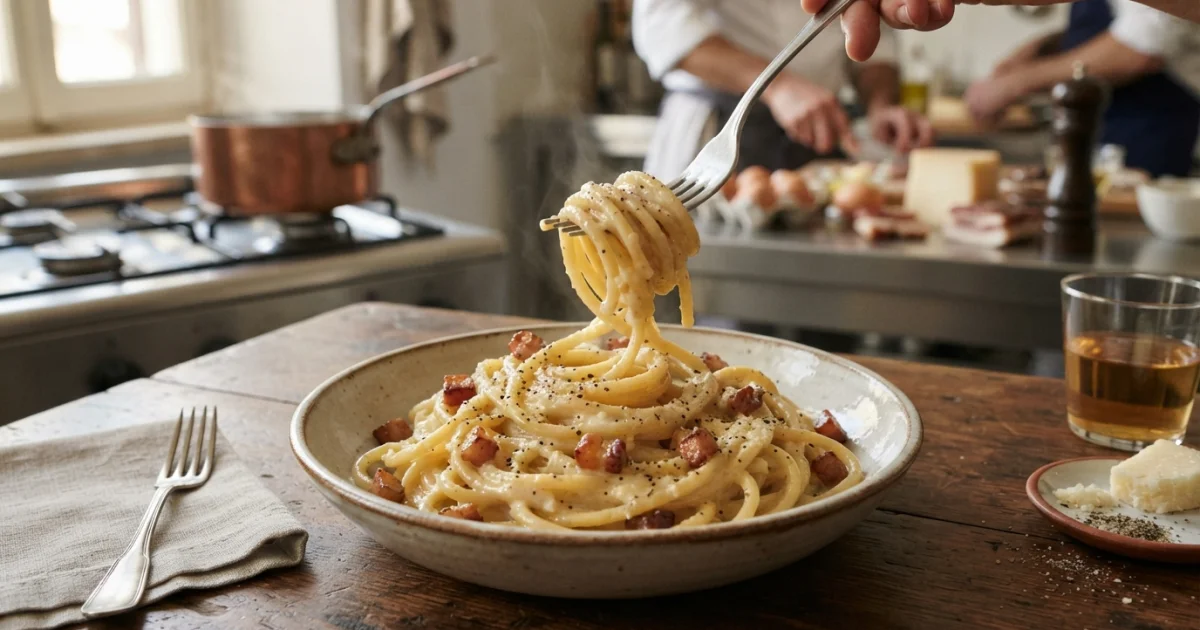
Walk into any bustling trattoria tucked away in Rome’s Testaccio or Trastevere neighborhoods, and you will hear a rhythmic, percussive symphony: heavy aluminum pans scraping against cast-iron burners, tongs twirling hot pasta, and the sharp hiss of rendered fat meeting starch water. Carbonara is not merely a recipe; it is one of Rome’s four sacred culinary pillars, sharing an unbroken lineage with cacio e pepe, amatriciana, and pasta alla gricia. Yet outside of Lazio, few dishes have suffered greater indignities. Let us be entirely clear from the outset: authentic Roman carbonara contains neither heavy cream nor butter. Its fabled velvet coating is not a product of dairy shortcuts, but an exquisite physical emulsion created between raw egg yolks, liquid rendered pork fat, sharp cheese, and starchy pasta cooking water.
The Five Sacred Ingredients of Roman Carbonara
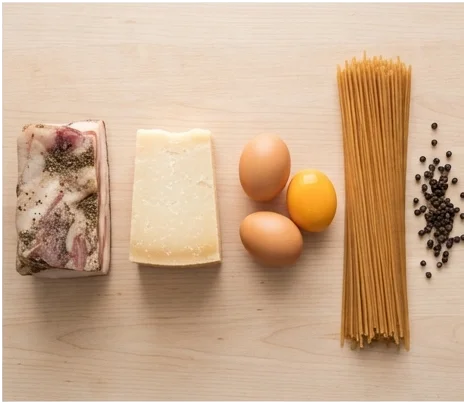
In traditional Roman cooking, minimalism is not a stylistic trend—it is a religion. When a dish relies on only five elements, there is nowhere for subpar ingredients or careless technique to hide. To cook an authentic carbonara, you must respect the integrity of every component.
- Guanciale: Cured pork jowl (cheek). Unlike belly cuts, guanciale is laced with dense, firm fat and seasoned with sea salt, black pepper, and occasionally herbs like rosemary and garlic. As it renders slowly over gentle heat, it yields a crystal-clear, intensely savory liquid fat that serves as the primary base for the sauce.
- Fresh Farm Eggs: The beating heart of the sauce. While old-school home cooks often debate whole eggs versus yolks, the restaurant standard among modern Roman chefs favors an egg-to-yolk ratio that prioritizes richness. For four diners, a balance of two large whole eggs and two extra yolks produces a silken, sauce-clinging texture without the watery lightness that excess egg whites introduce.
- Pecorino Romano DOP: A hard, aged sheep’s milk cheese native to central Italy. It is salty, pungent, and sharp with an earthy kick. Purists insist on 100% Pecorino Romano. However, if you find its salinity overpowering, an acceptable and widespread Roman compromise is a 50/50 blend of Pecorino Romano and aged Parmigiano Reggiano to round out the sharpness with nutty sweetness.
- Pasta: Bronze-die extruded (trafilata al bronzo) dry pasta is mandatory. The rough, chalky surface releases essential amylose starch into the boiling water and grabs the sauce. The two undisputed Roman favorites are thick spaghetti (such as spaghettoni) and ridged rigatoni, with fresh egg-based tonnarelli holding a close third.
- Black Pepper: Never reach for pre-ground pepper from a tin. You need whole black peppercorns, coarsely crushed in a mortar or cracked with the bottom of a heavy skillet, then lightly toasted in a dry pan to awaken their volatile oils and floral heat.
Guanciale vs. Pancetta and Bacon: Can You Substitute?
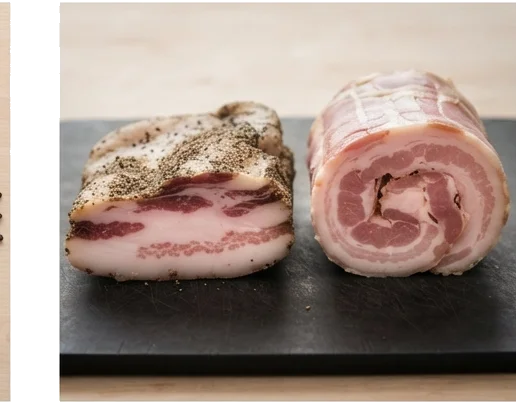
If you cannot source guanciale, understand the trade-offs before choosing an alternative. Guanciale comes from the pig’s jowl, which contains significantly more fat and collagen than pancetta, which is cured pork belly. Guanciale renders down into a pure, silky fat with an herbaceous, distinctively sweet-savory cure that defines true Roman carbonara.
Pancetta is an acceptable pinch substitute if it is unsmoked, flat (stesa), or rolled (arrotolata). It will provide salt and pork flavor, though with less unctuousness. Smoked American or British bacon, however, fundamentally derails the dish. The heavy woodsmoke, maple or sugar cures, and industrial brine overwhelm the delicate balance of egg yolk and Pecorino. Under no circumstances should you ever add olive oil or butter to your pan; authentic cured pork jowl releases more than enough luxurious liquid fat to lubricate the entire pan of pasta.
The Science of Emulsification: Preventing Scrambled Eggs
The greatest fear of the home cook attempting carbonara is ending up with pasta tossed with dry, curdled scrambled eggs. Avoiding this disaster requires an understanding of basic protein science.
Egg proteins begin to denature and coagulate at approximately 62°C (144°F), and by 70°C (158°F), they fully tighten and scramble, expelling trapped moisture. When hot pasta is pulled straight from boiling water (100°C / 212°F) and dumped directly over raw eggs in a skillet sitting on an active burner, the eggs cook instantaneously into rubbery curds.
To achieve a mirror-like, creamy glaze, you must create a suspension known as an emulsion. Rendered pork fat (oil) and starchy pasta cooking water (water) do not naturally mix. However, when whisked together with egg yolk—which is packed with natural emulsifiers like lecithin—the molecules bind. The suspended starches in the pasta water act as tiny physical wedges that prevent the fat droplets from coalescing and simultaneously shield the delicate egg proteins from clumping together. The absolute rule of Roman kitchen craft is this: the carbocrema must never touch an active heat source. The sauce is built exclusively using the residual warmth of the metal pan and the hot pasta strands off the stove.
Authentic Roman Carbonara: Step-by-Step Method
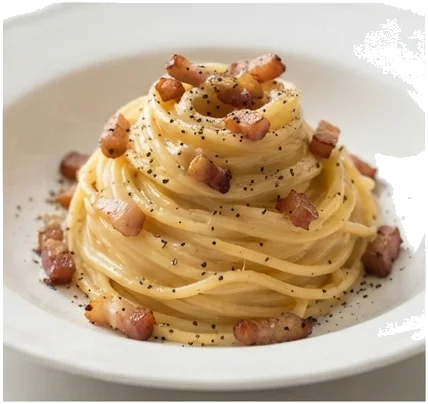
Before firing your stove, set up your workstation completely. Carbonara is an exercise in timing; once the pasta is boiled, the remaining assembly takes under ninety seconds.
| Ingredient | Metric Measurement | US Imperial Measurement |
|---|---|---|
| Spaghetti or Rigatoni | 350 g | 12.3 oz |
| Guanciale | 180 g | 6.3 oz |
| Fresh Eggs (Room Temp) | 2 whole eggs + 2 large yolks | 2 whole eggs + 2 large yolks |
| Pecorino Romano DOP | 90 g (finely grated) | 1 cup (firmly packed) |
| Black Peppercorns | 10 g | 2 tsp (whole, then cracked) |
| Coarse Salt (for water) | 15 g | 1 tbsp (scant) |
- Slice the Guanciale: Trim the hard outer skin (rind) from the guanciale slab. Cut the meat into uniform strips or batons roughly 0.5 cm (1/4 inch) thick and 2.5 cm (1 inch) long. Uniformity ensures even rendering.
- Render the Pork: Place the sliced guanciale into a cold, dry skillet or sauté pan without adding any oil or butter. Place the pan over low-to-medium heat. As the pan warms, the white fat will turn translucent and liquefy. Fry gently for 7 to 9 minutes, stirring occasionally, until the exterior is deeply golden and crisp, while the interior remains pleasantly chewy. Remove the crispy guanciale batons with a slotted spoon and set them aside on a plate, leaving the hot liquid fat in the pan. Turn off the burner.
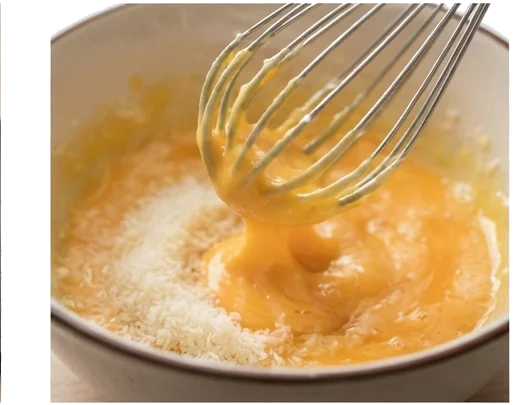
- Whisk the Carbocrema: In a medium mixing bowl, whisk together the two whole eggs, two egg yolks, and the finely microplaned Pecorino Romano. Add half of your freshly cracked black pepper. Whisk vigorously until the mixture transforms into a dense, uniform paste resembling pale gold mortar.
- Boil the Pasta: Bring 4 liters of water to a boil. Add only a modest palmful of coarse salt—far less than usual, as both the guanciale and Pecorino carry substantial salinity. Drop the pasta and cook it until it is approximately 1 to 2 minutes shy of al dente. Just before draining, use a heatproof mug to reserve at least 250 ml (1 cup) of cloudy, starchy cooking water.
- The Mantecatura (Emulsification): Transfer the drained, hot pasta directly into the skillet containing the warm, rendered guanciale fat. Toss the pasta vigorously over the residual heat of the unlit burner so every strand is coated in pork fat. Now, pull the skillet completely off the stove and set it on a cool counter. Let the pan rest for 30 to 45 seconds to let the temperature drop slightly below the danger zone of 70°C.
- Fold and Glaze: Pour the egg-cheese paste over the pasta. Immediately splash in 3 to 4 tablespoons of the hot, reserved pasta water. Toss and swirl the pasta continuously with tongs or a spatula. Watch the transformation: the thick paste, hot fat, and starchy water will rapidly homogenize into a glossy, velvety custard that clings tightly to every strand. If the sauce feels too stiff, splash in another tablespoon of pasta water. If it looks too loose, fold in an extra dusting of Pecorino.
- Plating: Twirl the pasta into warm bowls, creating tall nests. Pour the remaining creamy emulsion from the pan over top. Crown each portion with the reserved crispy guanciale batons, a final dusting of grated Pecorino Romano, and an assertive grind of cracked black pepper. Serve immediately.
Common Carbonara Sins and Mistakes to Avoid
Even seasoned home cooks fall prey to habits learned from bastardized versions of the recipe. Keep these six rules in mind to protect your dish from ruin:
- The Addition of Cream or Milk: Pouring heavy cream into carbonara is an admission of technical defeat. Cream masks the complex, cured musk of guanciale and the barnyard tang of sheep's milk cheese, turning an elegant, balanced emulsion into an unnecessarily heavy, cloying mess.
- Leaving the Pan on Active Heat: The single most common technical failure. The moment egg mixture hits a pan sitting over an open flame or an active induction burner, the proteins scramble instantly. The residual heat of the pasta itself provides all the thermal energy needed to cook the eggs safely.
- Using Refrigerator-Cold Eggs: Cold eggs drop the temperature of the pasta too rapidly and refuse to melt the grated cheese smoothly, resulting in a grainy, clumpy texture. Always bring your eggs to room temperature before whisking.
- Dumping the Pasta Water Down the Drain: That hot, cloudy water is your liquid gold. Without the dissolved starches to bridge the gap between liquid pork fat and egg proteins, your carbonara will split into greasy oil and chalky curds.
- Adding Garlic, Onions, Peas, or Parsley: While peas and mushrooms make lovely pasta bakes, they do not belong in a Roman carbonara. Aromatics like onions and garlic steam in the pan, sweetening the profile and competing directly with the pure pork fat and sharp Pecorino.
- Oversalting the Pasta Water: The golden rule of pasta water being "salty like the Mediterranean Sea" does not apply here. Between aged Pecorino Romano and salt-cured pork jowl, the sodium level is already high. Salt your cooking water sparingly.
The Surprising Origins of Pasta alla Carbonara
Given the fiery dogmatism surrounding carbonara today, one might assume the dish dates back to the Roman Empire. In reality, carbonara is shockingly modern—a post-war creation that is barely older than rock and roll.
Romantic folklore often attributes the recipe to the carbonai (charcoal burners) of the Apennine mountains, who supposedly prepared simple dry pasta tossed with hard cheese, cured pork, and black pepper resembling charcoal dust over campfires. While picturesque, historical records fail to support this tale. There is no mention of carbonara in classic early-twentieth-century Italian culinary texts, such as Ada Boni’s definitive 1930 compendium Il Talismano della Felicità.
The prevailing historical consensus points instead to the Allied liberation of Rome in 1944. As American troops entered the devastated capital, they brought military K-rations containing yellow powdered eggs and vacuum-sealed bacon. Starving local trattorie ingeniously combined these foreign rations with local Italian dried pasta and cheese to feed both Roman citizens and homesick GIs. The earliest known printed Italian recipe for carbonara appeared remarkably late—in the August 1954 issue of La Cucina Italiana. Fittingly, that inaugural recipe called for pancetta, garlic, and Gruyère cheese, proving that the rigid dogma of guanciale and Pecorino Romano was a standard codified by proud Roman purists decades later.
Frequently Asked Questions
Why is there no cream in authentic Italian carbonara?
Authentic carbonara relies strictly on a natural emulsion created by egg yolks, rendered pork fat, starchy pasta water, and finely grated cheese. Adding heavy cream masks the delicate cured flavor of the guanciale and turns a silky, balanced glaze into a heavy, greasy sauce.
Can I use bacon or pancetta instead of guanciale?
Unsmoked pancetta is the best practical substitute because it offers a clean pork profile, though it is leaner than pork jowl. Smoked American or British bacon should be avoided whenever possible, as its artificial smoke and sugar cures overpower the sharp, earthy balance of the egg and Pecorino.
How do I stop eggs from scrambling when making carbonara?
Remove the skillet completely from the heat source and allow it to cool for 30 to 45 seconds before adding your egg and cheese mixture. The residual heat of the pasta and the warm metal of the pan is more than enough to cook the eggs gently without pushing them past their 70°C (158°F) curdling point.
Which pasta shape is best for carbonara?
Spaghetti and rigatoni are the two definitive traditional choices. Bronze-die extruded spaghetti allows the glossy egg-and-fat emulsion to coat its long strands thoroughly, while tubular rigatoni traps both the sauce and the crispy bits of guanciale inside its ridges.
Can carbonara be reheated the next day?
Carbonara should be eaten immediately upon preparation and does not reheat well. Reheating the pasta in a microwave or skillet exposes the delicate emulsion to secondary heat, which instantly breaks the sauce and curdles the egg yolks into dry, scrambled bits.
Leave a Comment